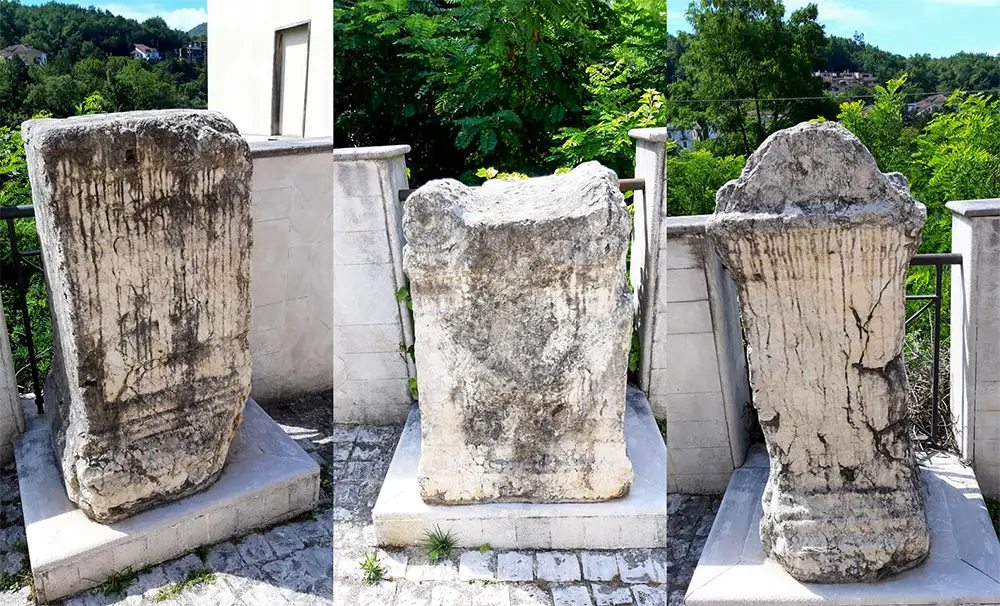
Of the grand Roman Atina, only a few visible remains survive today, while most of its heritage lies buried or has been damaged by time and neglect. In order to reconstruct the city’s history, archaeology is essential alongside literary sources, as it provides material evidence and concrete data—such as the altars exhibited here.
The are They were votive altars, symbols of elevation towards the deities. In the Roman world, the term “ara” referred to a sacrificial altar: a stone block, either cylindrical or polygonal, upon which propitiatory, purificatory and sacrificial rites were performed. These altars were often decorated with intricate reliefs depicting deities and mythological scenes. In the Hellenistic period, altars took on a monumental character, such as the’Ara Pacis in Rome or the’Altar of Zeus in Pergamon.
Dedicatory Altar
"Digizia Marcellina, daughter of Lucius, dedicates [this] to her excellent mother, Eria Mansueta, daughter of Quintus. The land required was granted by decree of the council of decurions."
Dedicatory Altar of Gaius Marius
Discovered in 1876 beneath the Vassalli Tower, in the bed of the Rio Cancello stream, this inscription mentions Gaius Marius, a farmer who tended the villa of the poet Martial in Atina.
“To the Divine Manes. Gaius Marius Mercurius erected [this] for Gaius Marius Januarius, freedman of Gaius, his most devoted and worthy brother.”
Go to the next point
Learn more about Atina

Atina Potens, Atina Sannita and its territory
“Quinque adeo magnae positis incudibus urbestela novant, Atina potens, Tiburque...

The ancient festivities of St Mark in Atina in the 18th century
In the heart of the Comino Valley, Atina has always cherished…
Municipality of Villa Latina in 1897
VILLALATINA Cassino electoral college. Diocese of Montecassino. Inhabitants 1691....


