Casalvieri, in the hamlet of Casale Pescarolo: over the years, agricultural work has brought to light a large number of clay votive offerings, mixed with fragments of black-glazed pottery, bricks and coins, concentrated around a now-abandoned farmhouse.
The artefacts, dating from between the 4th and 2nd centuries BC – although some date back to the 7th century BC – clearly formed part of a votive deposit and were associated with a sanctuary which could already be assumed to have been of great importance, given its location in an area of considerable strategic importance for trade routes, along the route leading from Val Roveto and Sora to Cassino and, branching off near Atina, continuing towards Abruzzo and Molise, forming the link between these regions and Campania via southern Lazio.
In the area from which the votive offerings were found on the surface, an extensive deposit was identified; subsequent geological investigations, together with stratigraphic data from the excavation, have made it possible to interpret this as having occurred in a body of water.
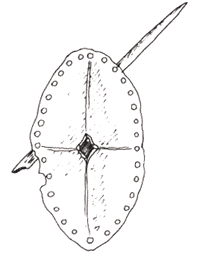
The votive offerings, most of which are miniature in size and are still being studied, confirm not only links with the Capua area and the Ansanto Valley, but also with other sanctuaries in southern Lazio, particularly along the river routes.
Beyond the historical, economic and artistic conclusions that will be drawn once the analysis of the material is complete, the votive offerings from the sanctuary at Pescarola provide a vivid insight into daily life in the area from the 7th to the 2nd century BC, through the weapons (7th–5th centuries BC), belts (Archaic period), coins (4th–2nd centuries BC), offerings for fertility (animal and anatomical votive objects), offerings relating to illness (anatomical parts affected by disease), masks, statuettes, and women’s hairstyles and jewellery (3rd–2nd centuries BC).


