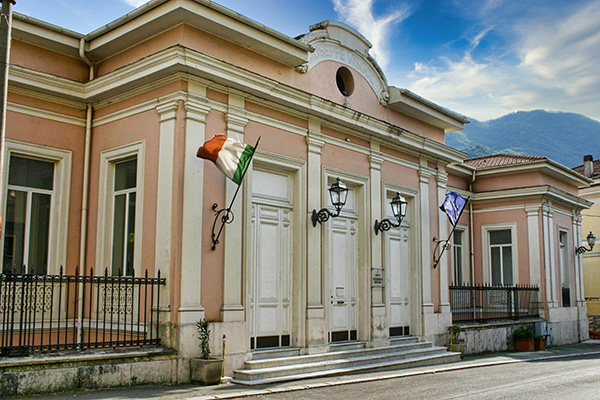
The Archaeological Museum of Atina and the Val di Comino (this is the new name which, from 2010, replaces that of the original Civic Museum (established in 1978) is housed in a former school building which, with its elegant classical-style façade, overlooks Via Vittorio Emanuele II. The building was constructed in the 1920s at the expense of a distinguished citizen Giuseppe Visocchi and named after him.
Alongside the museum, the building houses the well-stocked Municipal Library with a comprehensive section dedicated to local history and archaeology. Interest in Atina’s archaeological heritage has been kept alive over the years, not least through the work of local cultural associations, which now play a vital role in raising awareness and promoting the heritage in collaboration with the relevant authorities.
The museum collection, originally housed in the hall of the Doge’s Palace, has seen an increase in recent years in both the number and quality of archaeological finds, recovered not only in Atina but also from research and excavations carried out in other municipalities of the Comino Valley.
A significant boost to the development of the museum complex has come from the activities carried out in the Liri Valley area by the Archaeological Superintendency for Lazio and the various local councils.
These activities brought together at the Atina Museum, materials from, amongst other sources, the excavations at the The Italic Sanctuary of Pescarola within the municipality of Casalvieri and at the necropolis of Ominimorti, situated in the municipality of San Biagio Saracinisco. The availability of these finds has enabled the launch of a programme of regular exhibitions organised by the local council and dedicated in particular to exploring the pre-Roman period. At the same time, the museum uses regional funding to carry out regular restoration work on both the items in storage and those from the most recent excavations.
The exhibition layout, which opened at the new venue in 1997 and has been gradually expanded, is characterised above all by an extensive collection of pre-Roman earthenware, ranging from the well-known ribbed amphorae of the “Alfedena” and the ovoid jars attributable to the Archaic culture of the Liri Valley, right through to the elegant jugs (oinochoai) made of refined clay and bucchero, which attest to a certain degree of Etruscan commercial influence extending as far as these inland areas.
Among the oldest and most valuable artefacts, the bronze objects from the Orientalising period (8th–7th centuries BC) discovered at the beginning of the last century at the foot of the settlement in the village of San Marciano and now kept at the Pigorini Museum, of which a number of representative reproductions are on display (anthropomorphic and zoomorphic pendants, bracelets, openwork leaf-shaped brooches) which document, for the proto-urban centre of Atina, not only the flourishing of metallurgical production based on the exploitation of the Meta’s metal deposits, but also the existence of dominant aristocratic groups who undoubtedly held control over them.
The local metallurgical tradition characterises the entire pre-Roman period and is evident in the numerous iron and bronze weapons (spearheads and javelin tips known as sauroteres (in some cases, the remains of the wooden shaft are still visible), in the warrior’s equipment, such as the belts made of embossed bronze sheet, or in the iron horse bits. All these elements shed light on the fighting spirit of the Italic peoples who, like the Samnites, occupied the Atine countryside before the Roman conquest of 293 BC.
Some scale models are intended to evoke, particularly for younger visitors, this atmosphere of constant conflict between the Romans and the Italic peoples which characterised the Liri Valley for many decades and which has gone down in history as the “Samnite Wars”.
In Atina Archaeological Museum Two burials from the San Biagio Saracinisco necropolis: one older (6th century BC), consisting of a pit lined with stones containing the intact skeleton of a warrior accompanied by a rich grave goods assemblage, the other, with a double-pitched roof of large tiles and curved tiles known as “a cappuccina”, dating from a later period (4th–3rd centuries BC) and containing only a single black-glazed bowl alongside the meagre remains of the deceased.
Through the epigraphs, however, the people and society of the city – which had by then become Roman – and its surrounding territory are brought back to life. Thanks to the inscriptions and sculptural pieces from the Republican and Imperial periods, it will be possible to take a virtual tour of the urban and suburban monuments of Roman Atina (a populous town mentioned by Cicero himself as the most flourishing province) and, amongst the tombstones of citizens, freedmen and slaves, come across that of Munnia, a priestess dedicated to the cult of Ceres, or that of the local quaestor Gaius Timinio Gallo, or even that of the distinguished citizen Titus Elvius Basila, who donated no less than 400,000 sesterces for the upkeep of the young people of Atina.