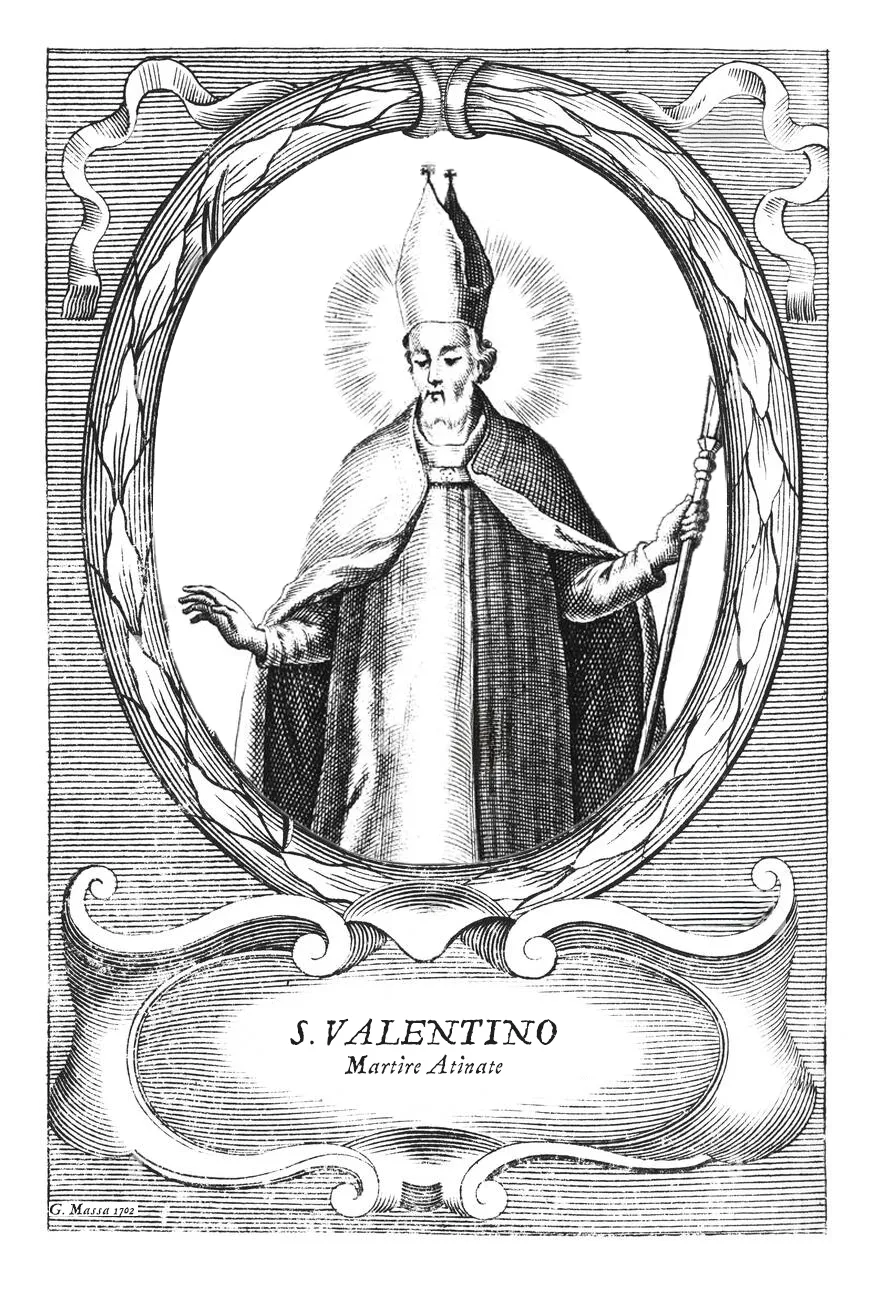
According to various ancient documents relating to the town of Atina, under the governance of Bishop Prudentius, during the reign of Diocletian and the prefecture of Timothy, the martyrdom of Saint Valentine – a noble and wealthy citizen of Atina – also took place. However, as there are no authoritative historical sources to confirm these events with certainty, I shall confine myself to reporting what the documents cited attest to.
Around the year 1644, the physicist Dr Giovanni Battista Panico, whilst recording certain events concerning his hometown of Atina, mentioned the martyrdom of Bishop Prudentius and Saint Valentine. He states that Bishop Prudentius, whilst in the Temple of Juno, near the Antonine Baths, was caught by the pagans whilst attempting to remove the idol dedicated to the goddess. For this reason, he was killed and his body was left on display for three days in front of the temple, until, one night, some Christians retrieved it and buried it in the church of St Peter.
Saint Valentine, himself a noble and wealthy citizen of Atina, was martyred on the orders of the consul Timothy during the reign of Emperor Probus.
In his brief account of the town of Atina, Dr Marco Antonio Palombo, after recounting the martyrdom of Saint Prudentius and Saint Valentine, wrote that, during the persecution ordered by Emperor Diocletian, Saint Valentine, a noble and wealthy citizen of Atina, was martyred.
Subsequently, the inhabitants of Atina built a church in his honour in Agnone, their town, where a monastery belonging to the monks of Montecassino was later established. This monastery was destroyed by the Saracens, but a certain Pontius Marso rebuilt it and, upon discovering that it belonged to the monks of Montecassino, returned it to them. In 1014, Prince Pandolfo of Capua confirmed this ownership with an official charter.
Leone Ostiense, in his Chronicles of Montecassino, recounts that, following the death of Abbot Leone, Prince Pandolfo of Capua confirmed the monks’ ownership of the monastery of San Valentino, situated within the same territory. This monastery, which had been destroyed by the Saracens, had recently been restored by Pontius, son of Allone of the County of Marsi. Having recognised the historical link with Montecassino, he returned it to the monks out of devotion.
An anonymous author, in a brief catalogue and summary of the deeds of the various princes who ruled the city of Atina around 1565, also recorded the martyrdom of Saint Valentine.
According to this source, Timothy, who was consul during the reign of Emperor Diocletian, had Saint Valentine martyred in Athens around the year 302. After his execution, the Christians recovered his body by night and in secret, and gave him a proper burial.
Text freely adapted from *Memorie istoriche dell’antica città d’Atina* by Tauleri Bonaventura, 1702