The beginning of the tragedy
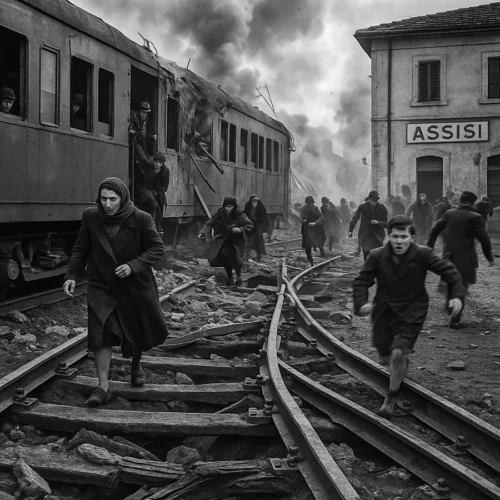
On 19 October 1943, the war came to Atina in all its cruel reality. Until that day, the roar of cannons and distant flashes had been nothing more than echoes from the Cassino front, but that night the roar of an aeroplane shattered the silence of the Comino Valley. Antonio Nardone, who lived next to the bridge over the Melfa, was jolted awake: a barrage of bombs fell near his house, causing the ground to shake. One of them exploded near Giuseppe Dragonetti’s house, below the “Costa” road; two others struck the area around the Visocchi paper mill.
Aware that they were in a strategic location, likely to be targeted by Allied bombing because of the bridge, Antonio and his family fled into the hills under cover of night. The aeroplane returned to fly over the area, this time heading towards Casalvieri, and dropped more bombs between the paper mill and the Guazzoli family’s home.
Antonio, who was barefoot as he fled, asked his brother Michele to fetch the shoes he had left at home. When Michele returned, he said he had seen a large crater behind the former Melfa cinema: clear evidence of a bomb that had just exploded. It marked the start of seven long months of bombing raids on Atina and the surrounding area.
Refugees and the exodus of the population
From the very first raids, the population realised that the city would soon become unliveable. Many citizens hid what they could not take with them: money, valuables and documents were stored in the cellars of the Cathedral, with the consent and assistance of Monsignor Arturo Di Cosmo.
But the parish priest’s generosity did not go unnoticed: the Germans began searching for him with the intention of hanging him, forcing him to flee for his life.
Atina was deserted within a few days. Those who were unable to leave found refuge in the caves and farmhouses scattered across the hills, whilst groups of desperate people arrived from neighbouring villages, intent on looting the abandoned houses: chairs, beds, linen, utensils – nothing was spared.
Among the displaced people from the Spineto district, the young Francesco Sabatini watched the German soldiers with mixed feelings: anger at their violence, but also a certain admiration for the discipline and physical strength with which they braved the morning chill, washing themselves bare-chested at the fountain in Piè le Piagge.
A country under siege
The sound of sirens and the roar of bombs marked the passing of the days. German troops had set up batteries and firing positions all along the Melfa and Mollarino valleys.
To evade Allied reconnaissance patrols, the vehicles were covered with green foliage and branches. The terrified inhabitants took refuge several times a day in the cellars and storerooms of the wealthier families, whilst the bridges and roads between San Biagio Saracinisco, Villa Latina, Atina and Belmonte Castello were under constant attack.
Roberto Fortuna, a lawyer who was forced by the Germans to take up the post of Municipal Commissioner, sought to protect the population by mediating between the military’s demands and the needs of the citizens, particularly the farmers.
But before long, all forms of local government came to a halt: the municipal offices were no longer functioning, the Citizens’ Food Committee was dissolved, and bread became a scarce and precious commodity.
Looting and small acts of kindness
As the weeks went by, the Germans became more aggressive. They raided farmers’ homes for wheat, oil and barley, and even confiscated the food people were carrying in their hands. Everything was stockpiled at the German Command, which was based in the premises of the Banco di Napoli in Via San Nicola, where part of the loot was resold to the starving population.
And yet, even amidst that horror, there were glimmers of humanity.
A German motorcyclist, who had been drinking at Antonio Leonardi’s wine cellar, fell into the River Melfa. Soaked to the skin and furious, he knocked on the Nardones’ door, armed, but was welcomed in and given first aid.
The next day he set off again, but he returned several times to say goodbye to that family, bringing them salt as a gift – a commodity that was extremely valuable at the time.
There was no shortage of soldiers who showed respect and were willing to help. Some helped Antonio Nardone deliver a pig he had sold to a relative, escorting him along the road to avoid it being requisitioned. Small gestures which, amidst the daily brutality, restored a glimmer of shared humanity.
The Bartolomucci family of Castellone and the German company
Meanwhile, in Castellone, near Picinisco, the Bartolomucci family was experiencing a different kind of occupation. Dr Renato Bartolomucci saw a German supply company arrive and set up camp on their farm, leaving the family with nothing but their home. They were older soldiers, veterans of the front, war-wounded men, with large carts and powerful, beer-coloured horses.
Renato’s mother, who spoke German, acted as an interpreter and managed to win the soldiers’ trust, securing protection and respect.
It was a marshal, nicknamed “Spiss” – the “boss” – who advised her to keep men away from the house: the risk of being rounded up or deported was extremely high.
From then on, Renato and his brother Giacinto, together with a few farmers, took refuge every morning in the woods above the power stations at Castellone. There they spent their days hidden amongst the oak trees, playing cards or reading, whilst watching helplessly as the bombings devastated Atina and the valley below.