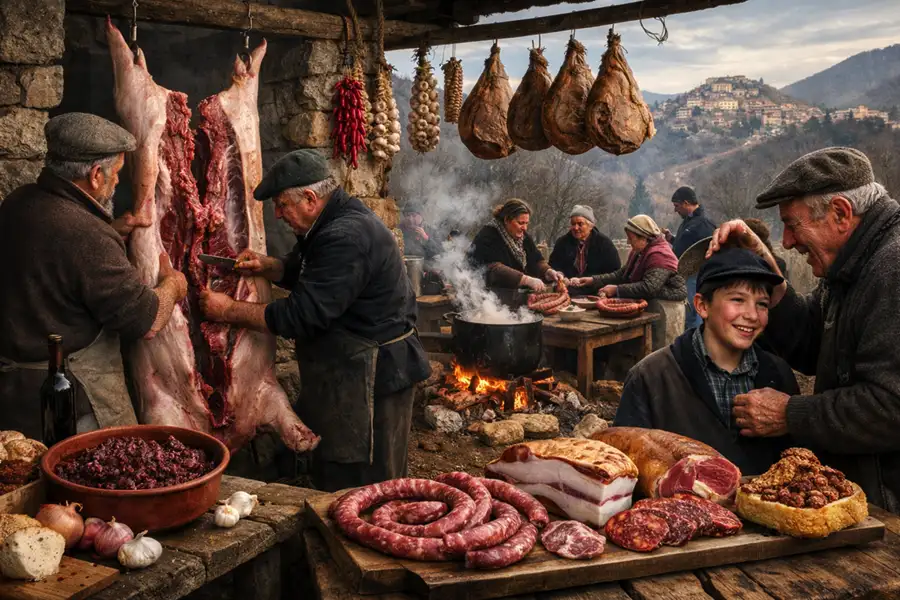
In the month of January, in the the countryside around Atina, the farmers’ lives revolved around one central figure: the pig. His presence set the pace the family, economic and social aspects of winter, representing a genuine a source of sustenance for the whole year.
The beast was purchased at the Foro Boario in Atina, a place for gatherings, bargaining and knowledge passed down through the ages, the beating heart of the local rural tradition.
Pig farming in the countryside around Atina
The pig was reared with great care. The fattening process involved a diet consisting of beetroot, bran (v’renna), green apples and acorns (ianna). Everything was cooked in a large big knife with salt and, once cooled, administered to the animal.
This attention to detail was no accident: a balanced diet ensured a firm, meaty and high-quality meat, which is crucial at the moment of the killing.
The pig slaughter: a collective winter ritual
La pig slaughter it always happened after the Christmas holidays, when the cold ensured better preservation and flies were no longer a threat.
It was a collective effort: six or seven men They pinned the pig down, tied it up and, with a swift movement, slit its throat.
The blood, collected straight away in a bowl, was cooked to make it set and then divided into several portions. As it could only be kept for a week at most, it was the first food to be eaten, cooked with onions or potatoes.
The black pudding, known as sprang up, was considered the real “the farmer’s ”wealth”.
Nothing from the pig went to waste: making full use of the meat
After being slaughtered, the pig was blanched in boiling water, hanging from the sturdiest hook in the cellar and split into two equal halves.
The intestines and guts, the v’ruella, were carefully cleaned and set aside for the preparation of the sausages. Nothing was to be wasted.
The head, stripped of its eyes, provided flesh and bones for a slow soup, cooked in the piñata by the gentle fire in the fireplace.
Hams, lard and traditional dishes
They used their paws to prepare the hams, seasoned with salt, pepper and chilli, a source of pride for those who knew how to prepare them to perfection.
The feet were salted and left to dry for forty days.
From the back, they used to make lard and ribs, to be cooked on the barbecue or breaded. The liver was used to make sausages for the sauce for the fire-eater or of the polenta, or it was eaten with sage, wrapped in a cloth.
From the fattest part, one obtained the lard, melted slowly over the heat. The residues, known as cicura, they became a real treat: mixed with maize flour and baked in the oven in the shape of a pizza, they were a real feast for the palate.
The feast after the slaughter
Once the slaughter was over, the farmyard was transformed into a a place for celebration and sharing. Also twenty or thirty people They used to get together to eat the homemade macaroni and the fried capicollo of the freshly slaughtered pig, celebrating the work that had been done and the solidarity within the farming community.
Student initiation rites and the transition to adulthood
There wasn’t even a a student tradition and initiation rite, typical of the local tradition. The pig’s genitals were thrown behind the animal’s split body and a a boy of about twelve, perched on a raised platform, he suddenly found it on his face.
Amidst the general laughter and the young man’s embarrassment – particularly under the watchful gaze of the women – his entry into adulthood.
A playful yet deeply meaningful gesture, which marked the beginning of a journey that was to culminate the following year in the the right to hold the knife during slaughter.


