
Italy in disarray and the turning point of 8 September
The summer of 1943 marked a decisive turning point in the history of Italy and daily life in Atina. After the Allied conquest of Pantelleria and Lampedusa in June, Anglo-American troops landed in Sicily on 10 July, forcing the Axis forces to retreat. A few days later, on 25 July, the fascist regime collapsed: Benito Mussolini was dismissed by the Grand Council and arrested by order of King Victor Emmanuel III.
The new government led by Marshal Pietro Badoglio started secret negotiations with the Allies and on 3 September signed the Cassibile armistice, which was kept secret until 8 September. When the news of the surrender became public, Italy plunged into chaos. The army dissolved, the units were left without orders, and the country found itself torn between the new alliance with the Anglo-Americans and the violent reaction of Nazi Germany, which had been an ally until the day before.
In the meantime, on 3 September, British General Bernard Montgomery's 8th Army crossed the Straits of Messina and landed at Reggio Calabria, before continuing on to Taranto. The Allied advance was now unstoppable.
The return of Luigi Bastianelli and the chaos of the early days
In this scenario of uncertainty and disorientation, the war also made its first echoes heard in Atina. Luigi Giuseppe Bastianelli, a starter on duty at the Grazzanise airport, found himself in the heart of the turmoil: the camp was in panic due to the arrival of the Germans and American bombing. Many, taking advantage of the confusion, attempted to return to their homes.
Early in the morning of 8 September, Luigi set off with an Abruzzese friend towards Sparanise station, hoping to reach Cassino. The streets were full of straggling soldiers and frightened civilians. At ten o'clock in the morning, after an exhausting journey and a shabby bicycle, Luigi finally arrived in Atina, joyfully welcomed by his family and girlfriend Anna Tamburrini. No one, however, imagined that this happiness would be short-lived: war was about to knock on the doors of the Valle di Comino.
9 September 1943: the Germans arrive in Atina
At dawn on 9 September, General Mark W. Clark's American Fifth Army landed near Salerno, meeting the fierce reaction of the German troops. That same day, the first cars with German soldiers appeared in Atina.
They stopped in Piazza Garibaldi, armed with machine guns, with a proud and threatening attitude. They got out of their vehicles, walked along the main streets, observing the astonished and frightened population, then drove off towards Cassino. But that was only the beginning. In the afternoon, other units arrived and immediately started requisitioning houses, foodstuffs and means of transport.
For Atina, a long period of fear, hardship and employment began.
Daily life under occupation
Among the earliest memories of those days are those of Chiara Cocchiara, then 11 years old. From his house in Via Vittorio Emanuele he saw German soldiers arriving, stopping the inhabitants to ask for housing and stables for their horses. The fear was great, but the people tried to obey.
In time, the little girl even managed to befriend some soldiers, receiving black bread and sugar cubes as gifts - small gestures that, in an era of hunger and rationing, had immense value.
Already before the armistice, the regime had forced the handing over of gold and wedding rings, copper and even tyres. As soon as they arrived, the Germans requisitioned all the remaining cars. Chiara's father had to hand over his own car, and shortly afterwards also the radio, which was taken to the municipal office at his own expense.
Atina became an occupied town: the soldiers installed themselves in every house and cottage, occupied the Circolo dell'Unione, the headquarters of the Red Cross and the Palazzo Visocchi, where they set up a military headquarters. The Bank of Naples, the schools and even the Carabinieri barracks were taken by force. The marshal and his men were disarmed and removed.
Terror and the signs of the regime
The atmosphere soon became gloomy and suspicious. On the night of 12 September, the news of Mussolini's liberation by the Germans triggered fascist shouts and chants in the village. The next day, photographs of Hitler and the Duce were hung under the Assunta Arch, guarded for eight days by night watchmen: a disturbing symbol that marked the return of the shadow of totalitarianism.
The stories of the displaced
Many inhabitants decided to flee. Among them was the family of Dr. Renato Bartolomucci, who left his home in Via Vittorio Emanuele to take refuge on the Castellone farm in Picinisco. 1 October 1943 - St Mark's Day - was the date on which young Renato left his birthplace forever.
Meanwhile, men like Raffaele Coppola, a soldier serving in Turin, were desperately trying to return to their families. He left on 8 September and took twenty days to get home. A German soldier offered him a lift in a sidecar to Atina: a journey full of fear and tension, which ended with a shared coffee in Piazza Saturno, in a surreal moment of truce between enemies.
Requisitions and economic devastation
On 10 October 1943, the Germans started to dismantle the machinery of the Visocchi Paper Mill, an industry that had provided employment for over three hundred families for a hundred years. Within eight days, the machines, stocks and over four thousand quintals of paper were loaded and sent to Germany. The factory was looted and devastated, marking the end of one of the most important economic activities in the Comino Valley.
Atina in the Gustav Line: a strategic node
With the Allied advance towards Cassino, the Germans turned Atina into a focal point of their Gustav Line, the great defensive barrier across Italy from Ortona to Gaeta.
Atina was a strategic junction for the connections between Cassino, Roccasecca and Sora, as well as a crossing point to San Biagio Saracinisco, Cardito and the Mainarde. Hitler himself, in November 1943, ordered that the Gustav Line be made “as strong as a fortress”.
The German troops thus established themselves in the villages of the Comino Valley - San Biagio, Picinisco, Settefrati, Villa Latina, Belmonte Castello - turning each village into a fortified rear. The population, meanwhile, was reduced to hunger and fear.
The winter of 1943 and the approaching battle of Cassino
On 13 October 1943, the Badoglio government declared war on Germany, but it was a more political than military gesture: the Italians, now unarmed, were employed as porters and labourers for the Allied army.
At the same time, the Allies crossed the Volturno, advancing slowly through rain and mud towards the Garigliano and Rapido valleys. In front of them stood Cassino, the heart of the German defence.
At Montecassino, the abbot Diamare and Colonel Schlegel, of the Hermann Göring division, coordinated the evacuation of the works of art, which were brought to Rome to save them from destruction. The operation lasted from 16 October to 8 December 1943.
By the time the monks also left the abbey, the war was on Atina's doorstep.
The German occupation in Atina represented one of the most dramatic periods in its history. The population experienced months of fear, hunger and deprivation, but also of silent courage and moral resistance. Families divided, houses requisitioned, industries plundered and sacred places violated remained imprinted in the collective memory of the Comino Valley for a long time, a prelude to the tragedies of 1944 and the future liberation.
Other interesting things...

The first bombs on Atina and the great exodus (1943–1944)
The beginning of the tragedy On 19 October 1943, the war arrived…

The German Occupation in Atina (1943-1944)
Italy in disarray and the turning point of 8 September The summer of...
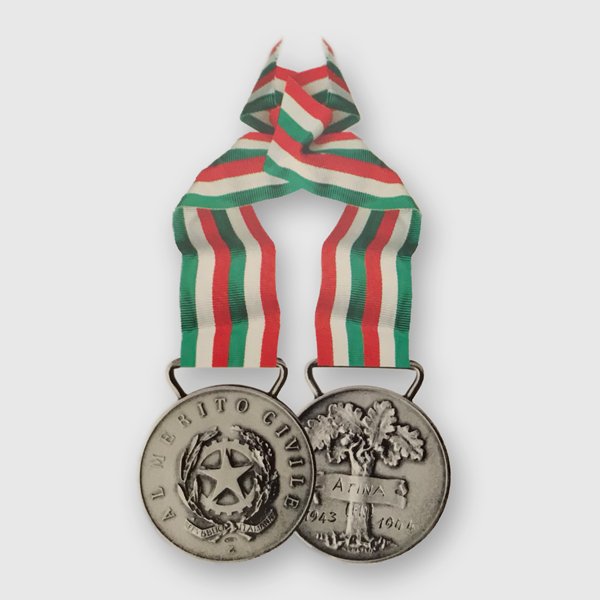
Atina, 70th anniversary of the Liberation
On the 70th anniversary of the Liberation FOR A DISTINCT OF HONOUR TO THE MUNICIPALITY OF...
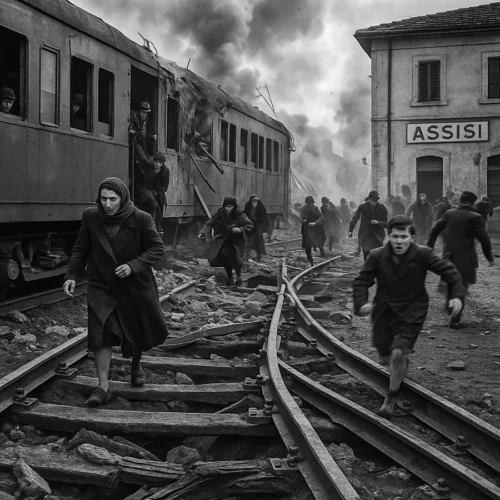
The Second World War: The Atinates Rescued in Assisi
A forgotten story from the Second World War: the people of Atina who were saved…


