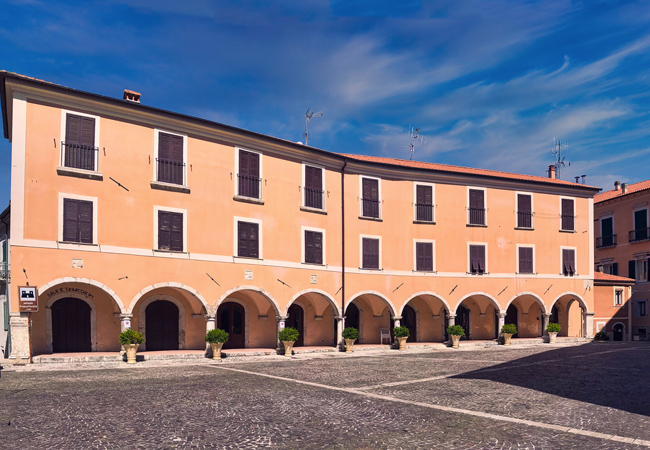
The Prepositural Palace, known as “Le Pennate”, stands out for its elongated, slightly curving shape, dominated by a severe portico covered with cross vaults, defined by eight reused Roman columns and two external quadrangular pillars.
Together with Palazzo Cantelmo and the façade of the Cathedral of Santa Maria Assunta, it defines Piazza Marconi (formerly Piazza San Giovanni), the heart of the historic center.
The Palagio San Marco
The Palagio San Marco was built under the patronage of Cardinal Tolomeo II Gallio, Duke of Alvito, to provide accommodation and a meal for those, both locals and visitors, who came to Atina during the patronal feast.
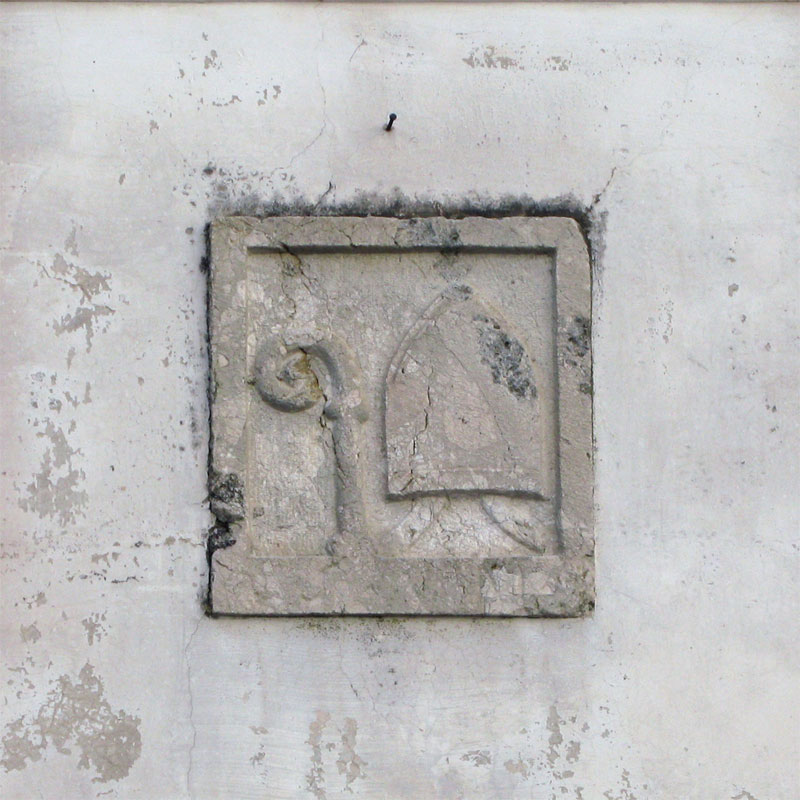
In 1598—based on a project by Giovanni Battista Onofri from Atina—Medoro Mancini and Giovanni Persechini, rectors of the Confraternity of San Marco, began construction by expanding the houses of San Marco. The work was continued and completed in 1600 by Girolamo Tutinelli and Giacomo Di Paolo, stewards of the hospital.
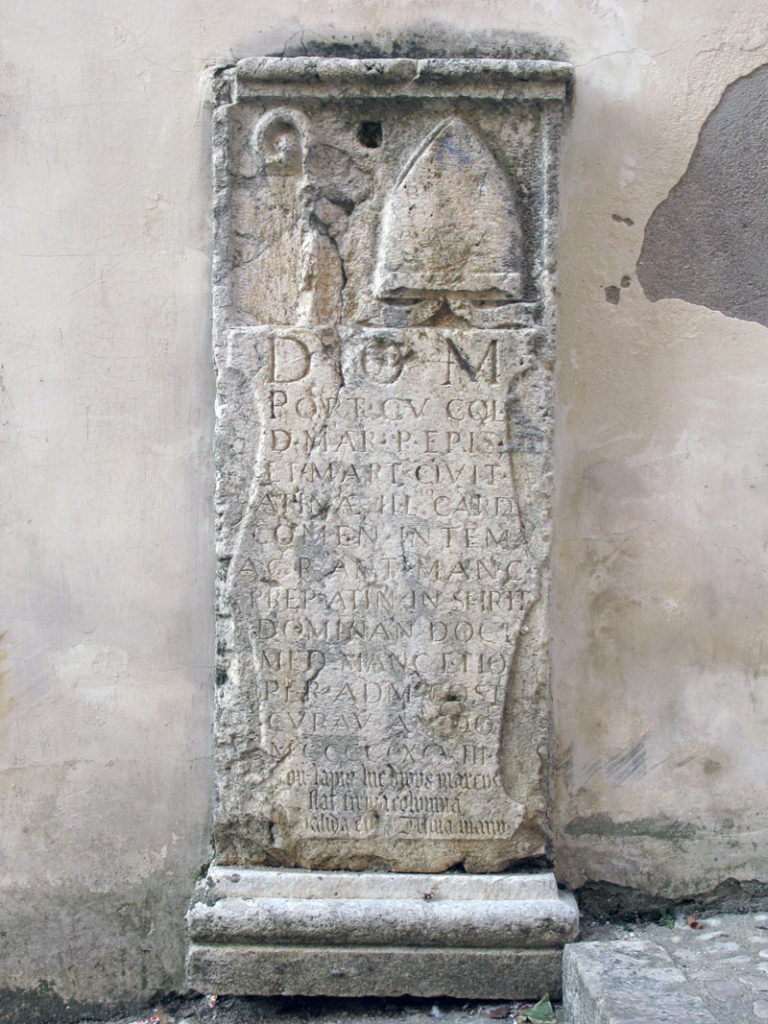
Two inscriptions commemorate its foundation:
“To God Maximus, porticoes with columns to St Mark the Pontiff. Bishop and martyr of the city of Atina, the illustrious Cardinal Comense at the time under the spiritual government of the Rev. Antonio Mancini, Provost of Atina, C.I. Medoro Mancini and Giovanni Persichini took care of the stupendous construction in the year of our Lord 1598”.”
Below, in Gothic script, it reads:
“Not this plaque, but Saint Mark stands like a steadfast column, from whose hand strong Atina is upheld.”
At that time, Atina’s clergy consisted of 12 canons and a provost who held "episcopal jurisdiction to correct and confer, and who used the crozier and mitre. Currently the Provost is Signor Antonio Mancino of Atina, a man of about 60 years of age, of fine character, Doctor of Theology, who served at the Roman Court of the Most Illustrious Cardinal Farnese of blessed memory. He is an experienced and courteous man, and lives comfortably, even though the provostship is worth no more than about 200 ducats per year.”
Despite its simplicity, the palace façade is adorned with small prepositural coats of arms, cornice moldings, and Roman-era artifacts.
Comino Valley, The Battle of Aquilonia and Cominio
The Battle of Aquilonia and Cominio The year that followed (293...
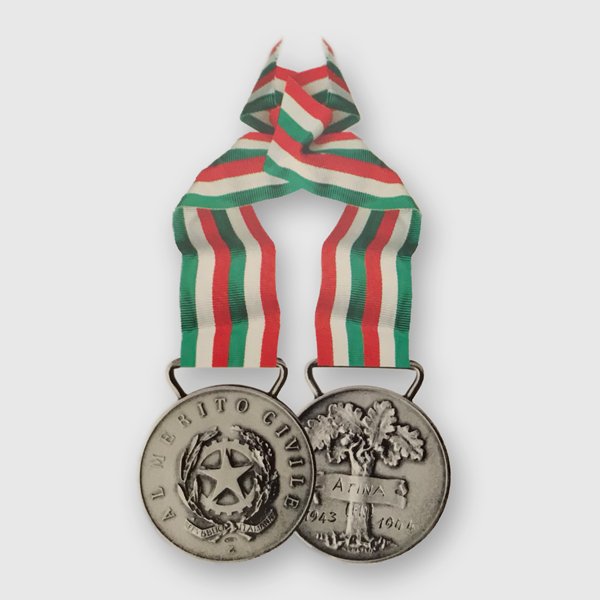
Atina, 70th anniversary of the Liberation
On the 70th anniversary of the Liberation FOR A DISTINCT OF HONOUR TO THE MUNICIPALITY OF...

St. Mark's reliquary arm Galileo
According to legend and reports in the Chronicon Atinense...


