Palazzo Visocchi in Atina: history, architecture and tours of the most important historic residence in the Comino Valley
The Visocchi Palace in Atina, one of the the most prestigious historic residences in Lazio, as it stands today, took on its current form between the first and second halves of the 18th century. The structure was redesigned by Gaetano Visocchi, a country estate in Terra di Lavoro, by combining and extending existing buildings to create an imposing stately home in the heart of the historic centre of Atina, in the Comino Valley.
The origins of the Visocchi family and the transformation of the palace
The building has belonged to the family since it was first built Visocchi, which settled in the Val di Comino at the end of the 16th century thanks to a privilege granted to the standard-bearer Biagio Visocchi, an officer of the Kingdom of the Two Sicilies, originally from Northern Europe, probably Poland. Over the centuries, the Visocchi family held military and administrative posts right up until the unification of Italy; a cadet branch – the so-called Visocchi outside – he also distinguished himself in the fields of industry, agriculture and politics.
Notable figures born in the palace include:
-
Monsignor Aniceto Ferrante (1823), Bishop of Gallipoli.
-
Luigi Visocchi (1899), engineer and collaborator of Umberto Nobile in the construction of airships for expeditions to the North Pole, and later also worked in Russia in the 1930s.
18th-century architecture and interiors
The Visocchi Palace It is one of the last great architectural achievements of the 18th century in Atina. The building, characterised by a T-shaped layout, dominates the entire area with its north façade Comino Valley and blends seamlessly into the architectural fabric of the old town.
The exterior retains elegant late-Baroque features, wrought-iron railings and its original 18th-century layout. Inside, the complex 18th-century layout, spread over several levels, remains intact:
-
Cellars and large service areas (the “big cellars”)
-
Service plan, including kitchens and pantries
-
Main floor or reception floor, with living rooms, a gallery and bedrooms
-
Private flats
-
Granaries
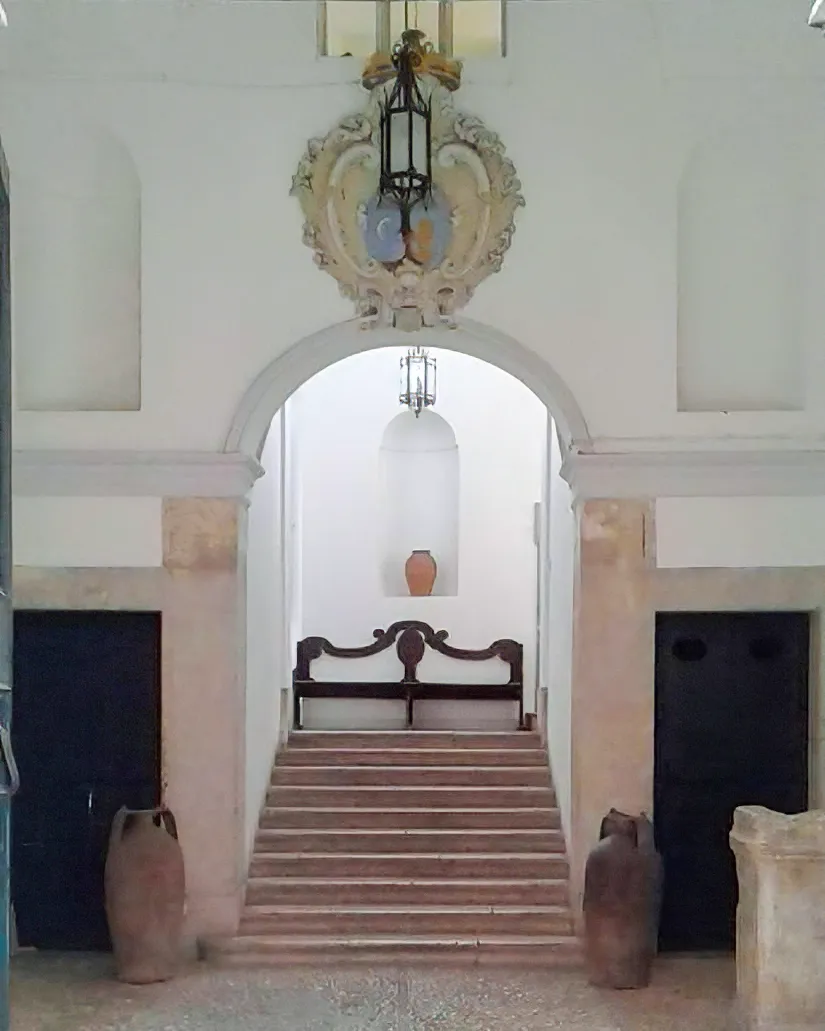
The main entrance leads to a entrance hall with a barrel vault, a floor of pebbles and terracotta tiles, alcoves, mouldings with mixed curves, and an imposing staircase decorated with the family coat of arms – elements that create a setting with an unmistakable neoclassical style.
The gallery and the halls
The main floor comprises the grand 18th-century gallery, flanked by spacious, ornately decorated halls. The central hall features neoclassical motifs on the walls and a frescoed vault with mythical figures associated with Mercury, one of the most significant examples of the house’s paintings.
The frescoed rooms and the “French” wallpaper”
The bedrooms feature tempera paintings depicting Four Seasons, whilst the dining room features a very rare French wallpaper from the Lefevre Paper Mills in Isola del Liri, produced in the early 19th century using the paper machine process: a true treasure of Italian industrial archaeology.
The Private Chapel of Our Lady of Loreto
One of the most charming rooms in the house is the Private chapel, with a chorus, dedicated to Our Lady of Loreto. The chapel, which is accessible from inside, is still open to the public during the celebrations dedicated to Our Lady of Loreto and to the Corpus Christi, according to ancient Athenian traditions.
Craftsmen, artistic influences and architectural design
A stylistic comparison with the Neapolitan region suggests that some of the main construction phases involved craftsmen from that area. Archival documents also mention stonemasons and ironworkers from Abruzzo, in particular from Alfedena e Pescocostanzo.
The Visocchi archive also reveals the name of the architect responsible for the 18th-century extensions:
Rocco Bernasconi, a professional who worked for the Abbey of Montecassino and was part of the Vanvitelli circle, mentioned in the writings of the historian Don Angelo Pantoni.
What to see
Go to the next point
Learn more about Atina
Origine della Chiesa di Santa Maria nella tradizione di Atina
Atina, nel cuore della Val Comino, vanta una disposizione urbanistica unica,…

Municipality of Settefrati in 1897
SETTEFRATI Electoral College of Sora. Diocese of Sora. Inhabit. 2582....
The Comino Valley, The Age of Myths and Heroes
MAGIC COMIN VALLEYMinimum history (for primary school use)The age...
The Tauleri family of Atina
The now extinct Tauleri family of Atina in the 17th century....


