March was the month of awakening. The land, after the long winter, was breathing again under the strokes of the spade. The furrows for the wheat were prepared, the clover and alfalfa seedlings for fodder were transplanted, and already in the first days of the month, pruning was carried out, a patient gesture that promised future fruits. The air became sweeter, the countryside filled with new light, and the bees, at dawn, settled lightly on the flowers to feed on nectar and dew.
Among the first spontaneous gifts of the season were primroses, the caciole, also good to eat, and the wild asparagus that sprouted tenaciously among the rocks, along with the gl’ lop'ra, another local variety. Nature was offering, and the community was preparing to celebrate one of the most anticipated moments of the year: St Joseph's fair.
The March fair was a buzz of voices, handshakes and haggling. The stalls were finally filled with agricultural products and goods of all kinds. From Cassino, via the tracing, merchants arrived on horseback. They were looking for the dregs, the pasty layer deposited at the bottom of emptied barrels, useful for the preparation of liqueurs; they also demanded snails and the raci, the condensed wine that crusted the inside of the barrels. The horses, meanwhile, stopped in the village with negl’ bucch full of bran and s’ lluch'ra - sweet, hard carobs - which also made the boys keen to suck the seed patiently.
The fair was not just commerce: it was collective memory, identity, devotion. On 19 March, St Joseph, the “carpenter”, protector of craftsmen and the family, was honoured. In Atina, the occasion was lived with intense religious participation, but also with a concrete and profoundly symbolic gesture: the “Lunch of St Joseph”.
St Joseph's Lunch“: faith and sharing
The meal was held at noon on 18 March, the eve of the feast day. A separate table was set up in the house for three poor people representing the Holy Family: Mary, Joseph and Jesus. It was an act of faith and charity. Often the priest was called to bless the meal and the ancient prayer to St Joseph was recited, asking for protection for the family, the Church and the whole world.
The seven traditional dishes
After the prayer, seven dishes were served, prepared in abundance so that nothing would go to waste and so that other families could also receive a portion. They were given a single dish with small portions of each course, called St Gi'sepp’ lunches’.
The menu spoke of simplicity and substance: pasta and chickpeas (zitun’), lentil, bean and broad bean soups with stale bread, boiled cod with broccoli, sometimes fried, pepper salad a la c'mposta with olives and anchovies, and finally the ever-present zeppole di San Giuseppe, with or without cream. They would end with a coffee and, before taking their leave by reciting an Our Father, they would give a p'ccellat to the child who impersonated Jesus.
Maria Pia Bianchi remembers that in March, as a child, she used to help her mother with housework: looking after the animals, cleaning the farmyard, collecting wood. To take bundles of wood to the lime kiln, in the area of the Caves before Sabina, she received half a lira. But his real job was to lattara. With the donkey laden with earthenware piñatas containing about ten litres of milk, she went down from the contrada of Spineto to the old town, passing by the coast of Piè delle Piagge. On her head she also carried a basket of vegetables, which earned her about thirty pennies.
He used to wear ciocie, first made of pigs' trotters and leather ties, then replaced by wooden clogs that he dragged with difficulty over thick stockings. The clogs were sold by Rosa la scarpara; socks, if they were not made at home, were woven with skill by Loreta Tamburro and Domenica Pittore.
During the festivities, women wore traditional clothes consisting of several garments: white stockings, blouses, ciar'ca(skirt with suspender), gold or red belt, pearl necklaces, pendants, tulle handkerchief, fisciù, uammacil, starched sleeves, pinafore, shawl over the shoulders. Unmarried women wore a white flower, married women red. Men wore ciocie or zampitti, wool stockings with laces, knee breeches, a sash around the waist, a bodice, a white shirt, a black jacket and a ragged hat.
Daily life was no less intense than the feast. Pia sold milk house to house; if some was left over, Marietta under ’Le Pennate“ bought it to make scamorze. Sister Eufemia was a special customer: she paid half a lira for two litres and offered an intercession to Our Lady. On colder days, a hot cabbage soup was comfort and refreshment.
Sometimes we would go out to pasture. While sheep and cows grazed, she would study in her one-penny notebooks. Attending school in Sabina, where Angelina Lotito and Signora Antonietta taught, was a privilege that was not always guaranteed. After grazing, the cowshed was cleaned, manure was piled up in the fields (the right), tanks were filled with water and bran, and fodder was prepared - even with the harvested, washed and dried crabgrass.
In the evening, the family, often ten or twelve people, would gather around the fire fed with good oak wood, which produced light ash for the smooth. Never using the pt'ncun, grain sticks: they made too much smoke. In between chatting, they roasted chestnuts, chickpeas in the frssora pierced and the nevin’, pumpkin seeds. In the morning, in the cupboard, there were potatoes boiled or barbecued the night before.
Mrs Erminia remembered a life even more immersed in the countryside, shared with cows and calves. Unforgettable were the animal births: a large trapdoor in the middle of the room allowed one to watch from upstairs as the beast was about to give birth to calves, lambs or baby goats.
His father used to hunt thrushes and quails with a board tied to a rope: when the bird pecked the ground, often snow-covered, he would let go and the board would catch it. The meat would end up in sauce or white wine. He also fished for trout in the Melfa, either with his bare hands or with a sack net: they were cooked fried with cornmeal or boiled with oil and lemon. Delicious was the soup of ch'cciut, crayfish, served alone or with noodles.
Every household prepared preserves, sausages, jams, wine. When more modern methods were not known, tomatoes were crushed by hand, dried in the sun in the m'selle, then mixed with oil and salt and stored in earthenware jars covered with wilted cabbage leaves. The sauce simmered slowly in the crock pot, in the heat of the fireplace, seasoned with lard, v'ntresque and lard.
So it was March: work and faith, toil and sharing, land and family. A month of passage that brought with it the scent of spring and the living memory of a community united around its rituals, its flavours and its stories.
Traditions, month by month
October in Atina: San Marco, grape harvest and traditions
October in Atina: a month of faith, work and conviviality...
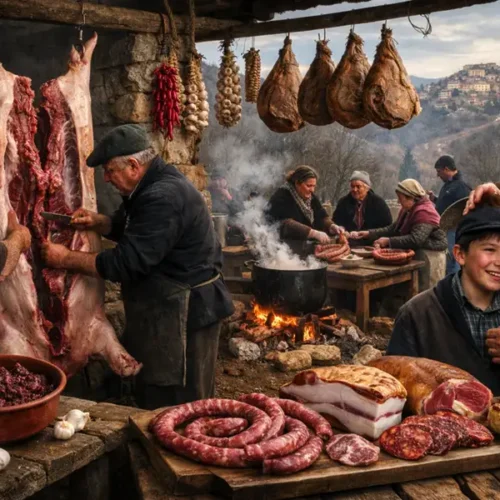
January in Atina: the time of the pig and the farming community
In January, in the countryside of Atina, the life of the peasants...
December in Athens: Christmas traditions and folk customs
December in Athens was a month full of charm and anticipation…
August in Atina: agricultural traditions and Feast of the Assumption
August among fields, harvests and popular festivals in Atina Ad...
Learn more about Atina
The Comino Valley, a mysterious valley
It is a land where history is intertwined with the...
Urban Development of Atina
This map shows the pattern of urban development in the centre...
Municipality of Villa Latina in 1897
VILLALATINA Cassino electoral college. Diocese of Montecassino. Inhabitants 1691....
S. Biagio Saracinisco, The Necropolis of Monte Santa Croce
The necropolis stretches across a series of limestone hills…


