The tragedy, destruction and rebirth of a town in the Comino Valley
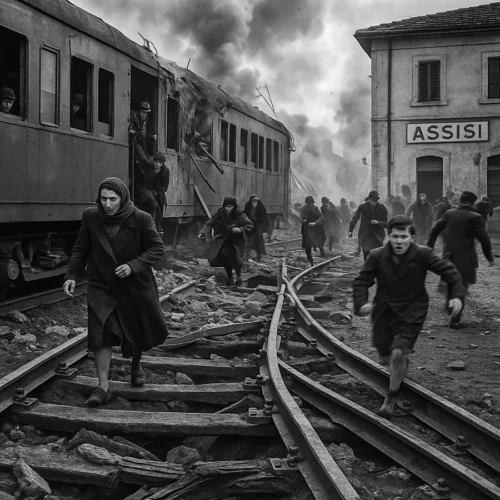
Amidst the hills of the Comino Valley, the town of Atina still harbours a deep and painful memory of the events that marked it during the Second World War. From 9 September 1943 to 28 May 1944 – the day on which the first New Zealand troops liberated Atina from the Germans – the population endured months of terror, deprivation and sacrifice, hiding amongst the rubble and in the cellars of the town’s buildings.
The early effects of the conflict and life under rationing
As early as 1942, the inhabitants began to feel the effects of the war. The government, in an attempt to meet the costs of the war, asked citizens to donate the gold wedding rings in exchange for simple metal rings. Around the same time, the food rationing: First there was a shortage of salt, then of other essential goods.
The black market became the only means of survival: wheat, meat and oil were sold at exorbitant prices, and it was not uncommon to find only dark bread and pasta, made with whatever flour was available.
The German occupation and the daily fear
Following the armistice of 8 September 1943, German troops systematically occupied Atina, requisitioned public and rural buildings, and confiscated livestock. The town, which had become the German army’s strategic rear As a key transit point on the route to Cassino and the Mainarde, it was soon swept up in round-ups, requisitions and acts of violence.
The population lived in constant fear of the air raids. The air-raid sirens sounded several times a day and the inhabitants rushed to take shelter in makeshift shelters. Many died of cold, hunger or in the bombings.
The dates of the most devastating air raids, as recorded in eyewitness accounts, mark a calendar of suffering:
- 1943: 19 October; 5, 12, 13 and 19 November; 13 and 28 December.
- 1944: 7, 14 and 20 January; 5, 15, 20 and 25 February; 15 March; 12, 13, 15 and 17 May.
The ravages of war almost completely destroyed the urban fabric. According to the Civil Engineering, the 95% in the town centre and the 50% in the countryside were razed to the ground.
Looting, violence and extreme hunger
The German gangs They did not confine themselves to the occupation: they looted every possession, set fire to houses, and killed and hanged civilians. Those who sought refuge in the mountains, with little food or clothing, were often discovered and robbed.
In just six months, Atina suffered a total devastation. In the historic centre, 49 people were killed and 28 injured, but the overall death toll exceeded 150 victims among the civilian population. Public buildings were destroyed, the Doge’s Palace It collapsed in several places; the churches were damaged or demolished. The streets were buried under rubble, the disruptions to water and electricity supplies, the hydroelectric power station and the bridges over the Melfa They collapsed. Even the cemetery was devastated by the bombs. Local industry — in particular the Visocchi Paper Mill — it was ransacked and mined.
With the winter of 1944 came famine. Dairy products and meat disappeared completely. People subsisted on bread made from re-ground bran, or from acorn and bean flour, which was dark in colour and bitter in taste. Soups were made from wild herbs, sorrel, chicory and turnips.
The Liberation of Athens
The 28 May 1944 (some witnesses recall the previous day), the troops New Zealand and British They reached Atina, bringing the German occupation to an end. But the liberation brought with it further destruction: Allied military vehicles occupied at least 21 properties and ravaged the cultivated fields.
Despite the dangers, the population — which had by then been evacuated — returned to the city immediately after its liberation, driven by the hope of to rebuild a house or recover some of the possessions that were saved. Many, unaware of the risks, took refuge amongst the ruins, trying to repair a roof or salvage household goods.
Tribute and Remembrance
The historian Pietro Vassalli, in the Famous figures in Athens (Arpino, 1956), wrote words that remain a moral testament to collective sacrifice:
«»Now these people, stripped of everything, who have suffered more severely than those who had the comfort of their homes and the household goods they managed to save, deserve to be remembered by future generations for the martyrdom of their ancestors, with a commemorative medal, a badge of honour or a certificate of merit’.
Dalla proposta alla medaglia d’argento
Nel 2002 il consigliere comunale Rolando Amata propose di avviare l’iter per ottenere la medaglia d’oro al valor civile in memoria delle vittime di Atina. La richiesta fu riformulata nel 2004, ma per mancanza di documentazione non poté concludersi.
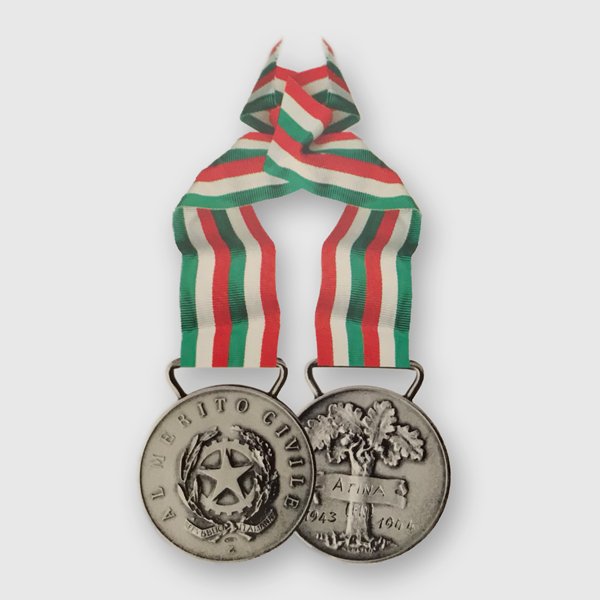
Due anni dopo, nel 2006, il sindaco Natale Cerri affidò l’incarico a Vincenzo Orlandi di preparare un nuovo dossier storico, corredato da fonti, documenti e fotografie. Grazie anche all’interessamento del Prefetto di Frosinone, dott. Piero Cesari, e del suo Capo di Gabinetto, dott. Ernesto Grossi, la città di Atina ottenne finalmente, il 26 giugno 2009, with Decreto del Presidente della Repubblica, the Medaglia d’Argento al Merito Civile.
La motivazione ufficiale recita:
«Comune situato ai margini della linea Gustav e a pochi chilometri da Cassino, occupato dalle truppe tedesche, subiva violenti saccheggi, devastazioni e continui bombardamenti che causavano la morte di numerosi cittadini, nonché la quasi completa distruzione del patrimonio edilizio. La popolazione, costretta a rifugiarsi nei paesi vicini, seppe resistere con fierissimo contegno agli stenti e alle dure sofferenze, per intraprendere poi la difficile opera di ricostruzione morale e materiale».
La memoria del sacrificio
Atina, dopo la distruzione e il dolore, seppe rialzarsi. Oggi le sue strade, i suoi palazzi ricostruiti e la sua gente custodiscono la memoria di quel tempo oscuro, affinché il tributo di sangue e dignità pagato dalla città durante la World War II non venga mai dimenticato.